 how-to
How to Verify Utility Savings Accuracy on Your Texas Bill
Last Updated: November 9, 2026
Quick Summary
To check utility savings accuracy, start with the Electricity Facts Label and compare total costs at your real usage: (kWh x energy charge) + base charge + (kWh x TDU delivery charge). A lower bill alone does not prove savings, since usage and rate changes can move it.
- An EFL shows three usage tiers, usually 500, 1,000, and 2,000 kWh, so compare at your own usage level.
- Pull 12 months of bills and flag estimated reads before trusting any baseline.
- If more than two of 12 bills are estimated reads, your baseline is not reliable.
- Separate the usage effect from the rate and fee effect when a bill changes.
- A $150 early termination fee can wipe out months of small savings.
Table of Contents
- Start With the Electricity Facts Label
- Run an Electricity Bill Calculator by Usage
- Work Through an Electricity Plan Bill Estimate Example
- Frequently Asked Questions
Start With the Electricity Facts Label
Checking utility savings accuracy starts with the Electricity Facts Label, the standardized PUCT document every Texas retail electricity plan must show. It lists the rate, base charge, TDU delivery charges, and contract length, and we treat the EFL as the source of truth for utility savings accuracy on any savings claim.
An EFL shows three usage tiers, usually 500, 1,000, and 2,000 kWh, so compare plans at your own usage level. Check the energy charge per kWh, base charge, TDU delivery charges passed through from Oncor, CenterPoint, AEP Texas, or TNMP, contract term and early termination fee, and rate type. A low energy charge with a high base charge can erase savings at low usage. Our advertiser disclosure explains how YOUtility may earn referral fees and why fees never change our ranking.
Run an Electricity Bill Calculator by Usage
An electricity bill calculator by usage multiplies your monthly kWh by the plan's energy charge, adds the base charge, then adds TDU delivery charges. Run it for all three EFL tiers, then match the tier closest to your actual usage.
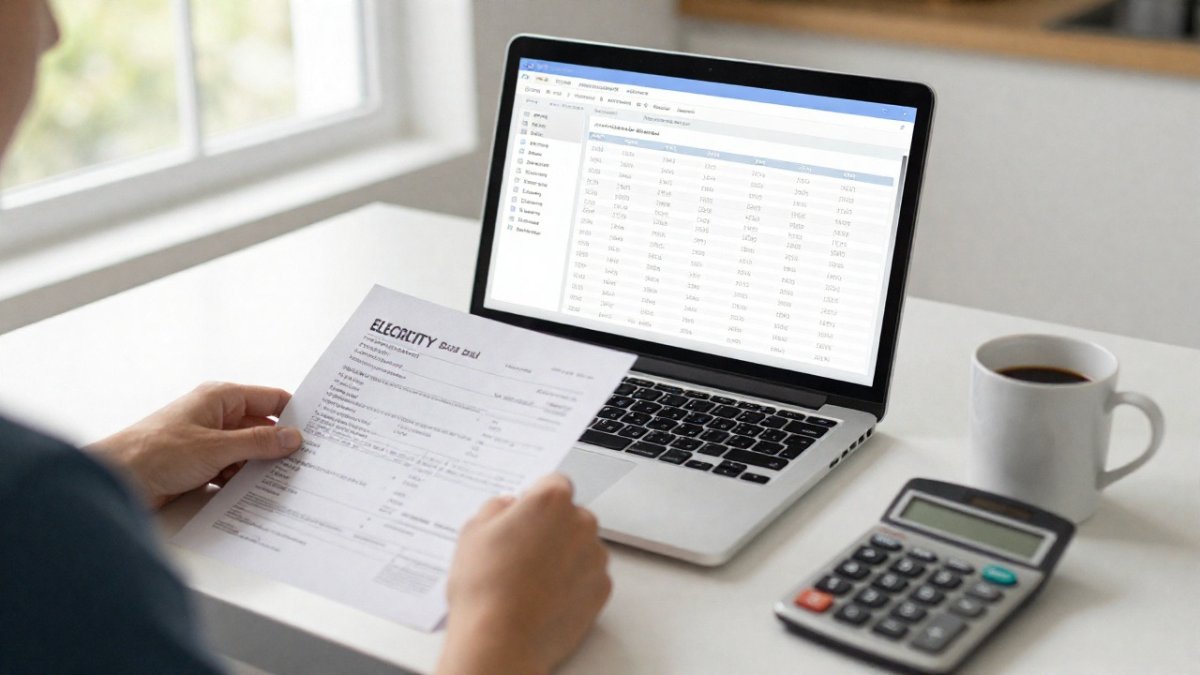
Pull your usage from past bills, not memory, and use a 12-month average to smooth out summer peaks.
- Gather 12 months of bills with billing dates, meter read type (actual or estimated), and kWh used.
- Build a baseline table of each month's kWh and total billed amount, flagging estimated reads and gaps.
- Fix data-quality problems first, prorate odd cycles to a 30-day month and note meter swaps.
- Weather-adjust the baseline by comparing the same calendar month year over year.
- Apply the plan math at your real usage: (kWh x energy charge) + base charge + (kWh x TDU delivery charge), for your current plan and the one you are considering.
- Compare totals, not rates, a lower energy charge with a higher base charge can cost more at low usage.
- Document the result, including the date and EFL version, because rates change and plans get replaced.
Watch out: if more than two of your 12 bills are estimated reads, or your billing dates have gaps, your baseline is not reliable enough to confirm a savings figure. You can find your best utilities in 60 seconds and check your estimate against live Texas plans for your address.
Work Through an Electricity Plan Bill Estimate Example
Here is a worked example. Say a plan charges 9 cents per kWh, a $5 base charge, and TDU delivery of 5 cents per kWh. At 1,000 kWh, the math runs like this:
| Line item | Calculation | Monthly total |
|---|---|---|
| Energy charge | 1,000 kWh x $0.09 | $90.00 |
| Base charge | Flat monthly fee | $5.00 |
| TDU delivery | 1,000 kWh x $0.05 | $50.00 |
| Estimated bill | $145.00 |
Monthly total
These are example figures only, as of November 2026. Rates change, so confirm current numbers on the EFL, then run the same math on a competing plan and compare totals.
Now the part most guides skip: separating energy savings from cost savings. Suppose your baseline month used 1,200 kWh and your bill was $168. The next month you used 1,000 kWh and your bill was $145. Your bill fell by $23, but that does not mean you saved $23 through efficiency, you used fewer kWh and the rate you paid may have changed.
- Old rate total at 1,000 kWh: (1,000 x $0.09) + $5 + (1,000 x $0.05) = $145.00
- Old bill at 1,200 kWh: (1,200 x $0.09) + $5 + (1,200 x $0.05) = $173.00
- Consumption savings: $173.00 - $145.00 = $28.00
The $28.00 is the usage effect. The difference between $28.00 and the $23.00 you actually saw is the rate and fee effect, if your rate went up, it eats into your consumption savings. Either way, the bill change alone is not proof of savings.
- Base charge timing. Switching plans mid-cycle may show two base charges in one month, a billing artifact, not a savings change.
- TDU charge changes. TDU delivery rates are set by Oncor, CenterPoint, AEP Texas, or TNMP and can change on their own schedule.
- Taxes and fees. Pull the actual billed total, not just the EFL estimate, when you compare months.
- Occupancy and equipment changes. A new appliance or thermostat change can move usage for reasons unrelated to the plan.
Also check the early termination fee before you switch, a $150 ETF can wipe out months of small savings if you move or change plans early. Texas gives you a 3-business-day right to cancel a new electricity contract, so use it if the numbers do not hold up.
Form EIA-861 utility data files show how customer enrollment and savings get tracked nationally. DOE measurement and verification guidance notes that bills may confirm a baseline depending on the method used. Vendor-reported results, such as EnergyCAP's 2026 customer report, are specific to those customers and do not predict your outcome.
Ready to compare live plans? Switch to a better energy plan and enroll online in minutes. Enter your address at youtility.app for a free, unbiased ranking.
Comparing plans takes minutes, but reading each EFL carefully is what protects your savings. YOUtility scores the options at your address with our Prometheus engine, shows a ranked best pick with the top 5 reasons, and never makes sales calls. We may earn a referral fee from some providers, and fees never change our ranking. This is not legal, tax, or financial advice. Enter your address at youtility.app for a free, unbiased ranking.
Frequently Asked Questions
How can I verify an electricity savings claim?
Ask for the Electricity Facts Label behind the claim, then rebuild the total yourself. Multiply your own kWh usage by the energy charge, add the base charge and the TDU delivery charges, and compare that total with your current plan at the same usage. A claim only holds up if the like-for-like total is lower. YOUtility may earn a referral fee from some providers, and fees never change our ranking.
Can an electricity plan's advertised rate differ from my actual cost?
Yes. The headline rate usually reflects one usage level, often 1,000 or 2,000 kWh. At other usage levels the base charge and TDU charges spread differently, so your effective cents-per-kWh can land higher or lower. Check the EFL price lines at your real usage before you treat an advertised rate as your cost.
How do early termination fees affect electricity savings?
An early termination fee is a fixed charge for ending a contract before its term ends. Add it to the cost of any switch you are considering. If the projected savings over the remaining months are smaller than the fee, staying put may cost less. The EFL states the fee amount and when it applies, so read that line before you sign.